A smarter way to move empty containers.
Empty containers are one of logistics' biggest inefficiencies. The way we reposition empties directly affects cost, emissions, and supply chain performance. Street turn offers a targeted solution, and the evidence speaks for itself.
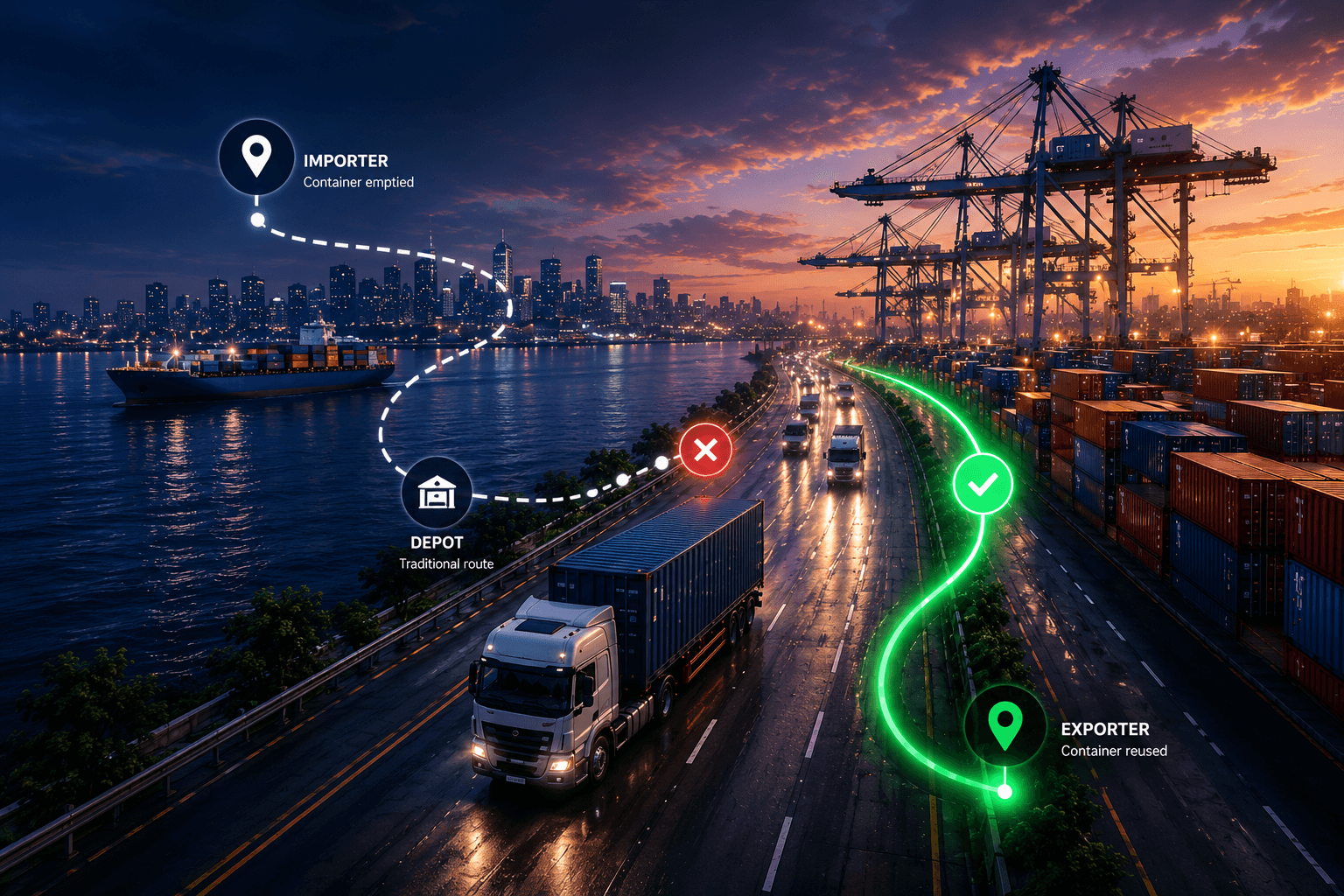
What is street turn?
After a containerized shipment reaches an importer, the emptied container usually follows one of four paths: sent to a port for global repositioning, returned to its owner, moved to a depot, or transported to a nearby shipper. Street turn takes that last option and makes it the default, moving empty containers directly from the consignee to a local shipper and skipping the depot entirely.
Lower transportation costs
Research confirms that when transportation cost is the critical factor, street turn is the superior strategy. Fewer trips mean lower fuel, driver, and handling costs across the board.
Fewer truck trips on the road
Every street turn match is one less empty container making an unnecessary journey to a depot and back. That directly reduces truck movements in and around port areas, a win for carriers, shippers, and the wider community.
Lower emissions
Fewer truck trips mean fewer emissions. As supply chains face growing pressure to decarbonize, street turn is one of the most practical, immediately deployable tools to cut the carbon footprint of container logistics.
Less congestion at marine terminals
Terminal congestion is driven in part by the constant in-and-out flow of empty containers. By bypassing marine terminals, street turn eases traffic pressure at ports and frees up capacity for loaded containers.
Tenant-isolated by default
Your moves only match within your own organisation. Cross-haulier matching is opt-in and stays off until liability terms are in place.
Tackling the root causes of empty container imbalance
The empty container problem is structural. It stems from trade imbalances, seasonal demand swings, mismatches in container types, and the sheer number of container owners in the market. Add inaccurate demand forecasting, limited ship space, and the difficulty of tracking containers across offices and regions, and the scale of the challenge becomes clear. Street turn does not solve all of these, but it directly addresses the local imbalance between supply and demand for empty containers, reducing the knock-on effects of these systemic causes.
Matching the right container at the right time
Street turn is not without its complexities. For a match to work, the right container type must be available at the consignee's location exactly when the shipper needs it. This alignment of time, location, and container type is the key operational hurdle, and where smart digital matching makes the difference.
Five steps from submitted move to recorded savings.
- 01
Availability
Submit empty returns and empty needs through the portal.
- 02
Match
The platform finds candidate reuses that fit type and timing.
- 03
Connect
Both operators dual-confirm within a 4-hour window.
- 04
Move
Reference number routes to the shipping line for approval.
- 05
Value
Savings recorded against the cost model you signed off on.
Let's turn empties into opportunities.
Book a 30-minute demo to see how Street Turn fits your week-to-week planning.
Book a demo